How to Choose the Right Basketball Hoop System and Prepare Your Property for Safe Installation
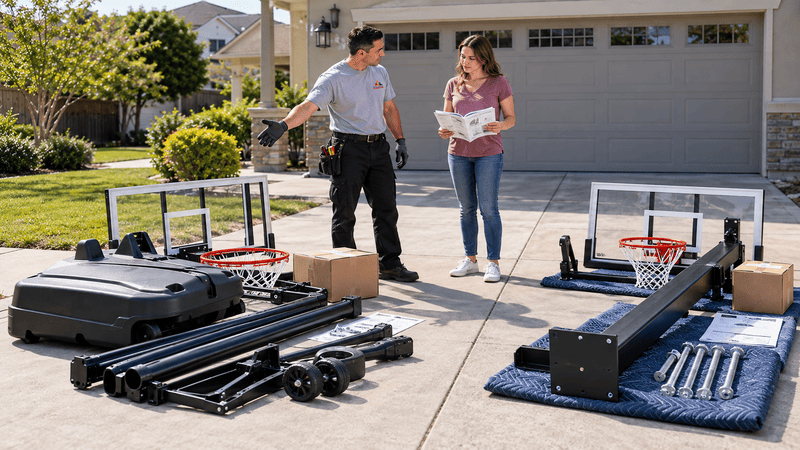
Choosing a basketball hoop starts with portability versus permanent placement, followed by space, surface conditions, clearance, installation requirements, and use. Portable systems typically rely on weighted bases. Many in-ground systems require manufacturer-directed ground preparation and concrete installation.
- Portable hoops offer relocation flexibility, subject to their moving instructions.
- In-ground systems require permanent placement planning.
- Driveway slope affects base positioning and setup.
- Clearance matters around the entire playing area.
- Manufacturer requirements guide assembly, ballast, and anchoring.
Start With the Hoop Type
Basketball Hoop Installation starts with matching the system to your property, not choosing the largest backboard. Buying for appearance alone can leave homeowners with limited driveway space, awkward pole placement, or insufficient clearance. A suitable hoop must fit both the available space and the intended use.
These problems often emerge after delivery. Sloped pavement can complicate portable base placement, while buried utilities can affect an in-ground location. Meanwhile, an unexpected mounting method may require groundwork you never planned.
Instead, compare the installation manual with your property before purchasing. Measure the playing area, identify obstacles, and consider who will use the hoop. Careful selection and property preparation help you choose equipment that suits the location.
Portable and In-Ground Hoops Compared
Neither system type automatically suits every property. Compare the complete design, including the base, pole, backboard, adjustment mechanism, and required installation work.
| Consideration | Portable basketball system | In-ground basketball system |
|---|---|---|
| Placement | Allows relocation according to manufacturer instructions | Requires long-term location planning |
| Support | Usually uses a weighted base and support pole | Uses the specified buried pole, sleeve, or anchor assembly |
| Groundwork | Usually avoids excavation, although some models require additional securing | Commonly requires excavation and concrete |
| Space | Base occupies space near the playing area | Footing location and backboard overhang shape placement |
| Height adjustment | Available on many models | Available on many models |
| Assembly | Can involve several pole sections, brackets, and a large base | Combines foundation work with pole, backboard, and rim assembly |
| Storage | Requires a suitable route and storage footprint | Usually remains installed |
| Playing feel | Varies with pole design, joints, backboard, and base | Varies with pole design, backboard, anchoring, and assembly |
Backboard size alone does not determine playing feel. Backboard material, pole construction, brackets, and component connections also affect rebound response and movement.
For younger players, compare height adjustment methods and approved adjustment ranges. Check who may operate the mechanism and how much surrounding space it needs.
A portable hoop may suit a rental property with changing recreation needs. However, “portable” does not mean effortless movement, especially after filling the base.
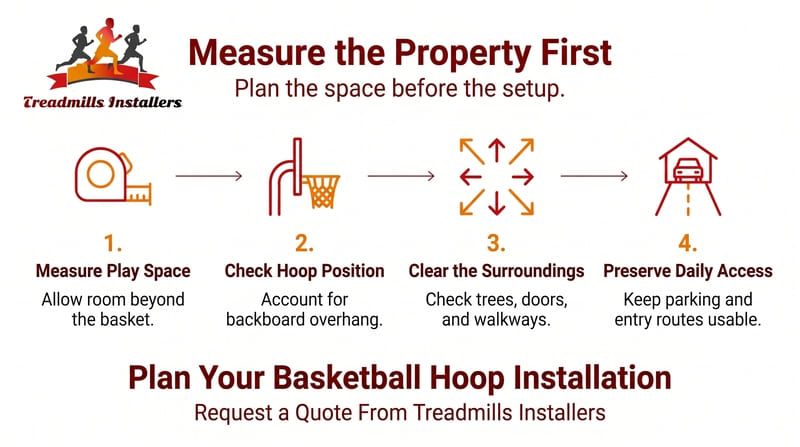
Measure the Property First
Plan the playing area before choosing the final base or mounting point. Measure driveway width, usable playing depth, surrounding obstacles, and access routes. Include the backboard’s position above the court, not just the pole location. This helps identify conflicts before assembly or excavation begins.
A driveway basketball hoop should fit everyday property use as well as shooting practice. Parked vehicles, open garage doors, and pedestrian routes can change the available space.
Use these measurements and observations during basketball hoop property preparation:
- Driveway width: Measure usable pavement after allowing for vehicles, walls, and landscaping.
- Playing depth: Consider movement toward the basket and space beyond the immediate shooting position.
- Boundaries: Confirm property lines and applicable local or association requirements.
- Door movement: Check garage doors, gates, and nearby entrances through their full travel.
- Overhead obstacles: Identify trees, branches, power lines, and other obstructions.
- Surrounding access: Account for walkways, neighboring property, and street proximity.
- Backboard overhang: Measure how far the backboard projects from its support.
- Player clearance: Allow space around the base, pole, and likely paths of movement.
Backboard Overhang Changes the Playing Area
Backboard overhang means the horizontal distance between the support and the backboard. It affects where the basket sits above the pavement.
For example, a pole beside a driveway may place the backboard farther into vehicle space than expected. Measure the selected model’s overhang before confirming that position.
Families in Washington, DC may need to balance narrow driveways with shared access. Treadmills Installers offers installation support for these residential projects. Avoid locations that encourage players to chase rebounds into traffic. Keep basketball hoop placement away from power lines and confirm relevant clearance requirements.
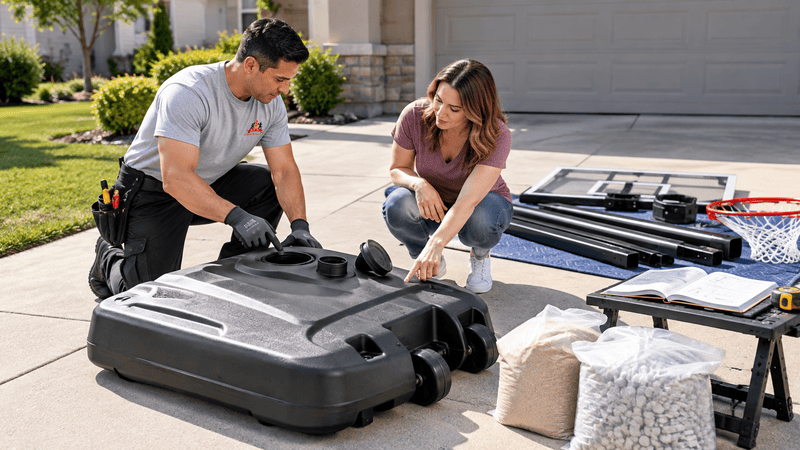
Portable Bases Need Planning
Prepare a portable basketball system by checking its base footprint, condition, ballast instructions, and intended surface. The base must sit as the manufacturer requires, without improvised supports. Plan relocation and storage before filling it, because added ballast changes how the system moves and handles.
Ballast is the weight inside or attached to a base that supports the system’s intended stability. The correct material and quantity depend on the model.
Some manufacturers permit water, sand, or specific alternatives. Do not assume that guidance for one hoop applies to another.
Check the Base Before Building Upward
Complete these checks before assembling the upper components:
- Inspect the base for cracks, damaged seams, and missing parts.
- Confirm that fill caps and seals fit correctly.
- Identify the approved ballast material and filling sequence.
- Check wheel attachment and the manufacturer’s moving procedure.
- Match support pole sections and braces to the illustrated instructions.
- Confirm the backboard brackets and rim hardware before lifting.
- Identify any additional manufacturer-required securing or anchoring.
- Choose a surface that meets the system’s placement requirements.
Water ballast requires attention to leaks, water levels, and freezing conditions. Sand also requires the specified quantity and filling method.
Use manufacturer-approved alternatives only when the instructions expressly allow them. Avoid improvised weights, additives, or attachments.
Slope Affects More Than Rim Height
A sloping driveway can tilt the base and pole. Raising or lowering the rim does not correct an unsuitable base position.
Do not use loose bricks or scrap wood to create makeshift leveling supports. If the surface cannot meet the manual’s requirements, choose another location or assess site improvements.
For residential projects in Maryland, professional portable basketball hoop assembly can help coordinate base preparation, pole assembly, and backboard attachment.
Before use, check rim alignment and the height mechanism according to the manual. Reassess the setup whenever you relocate the system.
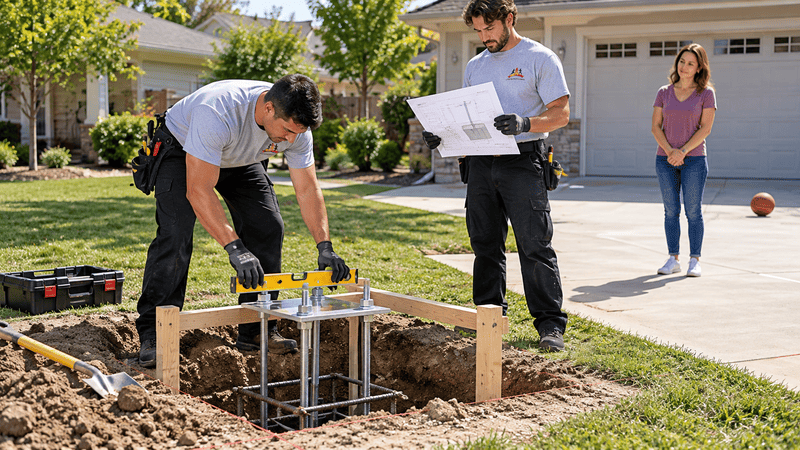
In-Ground Systems Need Groundwork
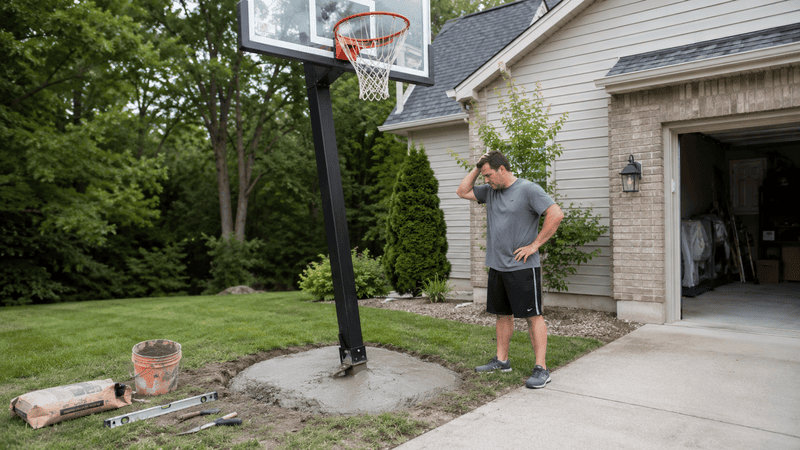
An in-ground basketball system needs a suitable installation location and foundation plan before upper assembly starts. Confirm the digging area, underground utilities, ground conditions, and specified mounting design. Hole dimensions, concrete requirements, anchor positioning, and curing instructions must come from the selected system’s documentation.
In-ground designs differ. Some use a pole set into concrete, while others use a ground sleeve or a bolted anchor assembly.
A ground sleeve receives a compatible pole. An anchor plate connects the pole assembly to embedded anchors.
Neither arrangement removes the need for manufacturer-directed foundation preparation.
Confirm the Foundation Before Excavation
Address these details before digging:
- Establish the pole location using the planned playing area and backboard overhang.
- Arrange underground utility marking through the applicable 811 process.
- Follow local notice periods and excavation requirements.
- Identify private underground lines that may require separate locating.
- Assess access, soil conditions, roots, rocks, and nearby pavement.
- Confirm the specified pole, ground sleeve, or anchor plate.
- Follow the required hole dimensions, concrete specifications, and reinforcement details.
- Plan alignment checks and the required curing period before loading the foundation.
Utility markings do not replace careful excavation practices. Irrigation, private electrical lines, or other owner-installed services may need additional attention.
Concrete that looks dry may not have reached the required condition for assembly. Weather and site conditions can also affect scheduling. Never substitute a generic footing size or curing timeline for the system’s instructions. The basketball hoop concrete footing must suit the specified installation design.
For Northern Virginia homeowners, professional in-ground basketball hoop installation can help coordinate foundation preparation with later system assembly. Confirm the work scope before booking, including who handles excavation, concrete related steps, and any separate site work.
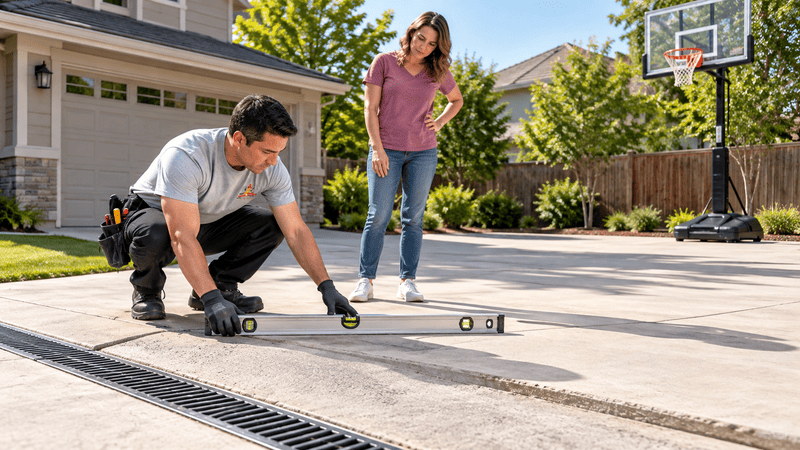
The Playing Surface Changes the Setup
A suitable basketball surface must support the hoop’s placement while providing usable space for play and property access. Concrete, asphalt, slope, cracks, drainage, and uneven pavement all affect planning. Some properties need a different location or separate surface work before installation can proceed. Concrete pavement does not automatically provide an acceptable foundation for an in-ground goal. The system may require a separate footing rather than attachment to an existing slab.
Likewise, an asphalt driveway does not automatically qualify for anchoring. Follow the selected design instead of assuming the pavement can support mounting hardware.
Check Pavement and Daily Access
Look beyond whether the driveway appears flat:
- Cracks and broken edges: Check whether the base would bridge gaps or sit on deteriorated pavement.
- Surface slope: Compare the proposed position with the manufacturer’s placement requirements.
- Drainage: Identify standing water and runoff paths around the base or footing.
- Uneven pavement: Watch for rocking, unsupported contact points, and abrupt changes in level.
- Vehicle access: Preserve necessary turning, parking, and entry space.
- Door clearance: Account for moving doors and the full assembled hoop.
- Playing clearance: Keep fixed obstacles outside the intended movement area.
In Delaware, a backyard installation might need careful planning around drainage channels and patio edges. Installation alone cannot correct every surface defect. Similarly, Pennsylvania property owners may need separate pavement repairs before placing a portable base. Treadmills Installers provides basketball system installation services across both states.
For properties with several activity areas, outdoor recreation structure installation services can support broader equipment planning. Keep basketball play space distinct from nearby recreation equipment and pedestrian routes.
Preparation Prevents Installation Surprises
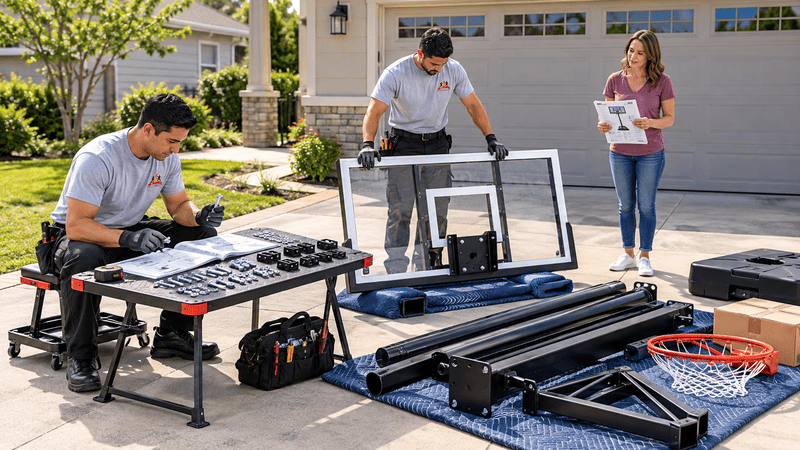
Professional assistance becomes practical when component weight, assembly steps, or groundwork exceed the homeowner’s available help and tools. Heavy backboards, long poles, and multiple brackets require careful coordination. Sharing the model number, manual, property photographs, and access details helps define the work before installation begins.
Basketball Hoop Installation involves assembling, positioning, leveling, securing, and checking a basketball system. The process follows its design, manufacturer instructions, property conditions, and intended use.
Professional basketball hoop installers can reduce installation guesswork and help keep major components organized. Multiple installers may be necessary for lifting and supporting heavier assemblies.
For basketball backboard installation, mounting brackets must match the correct orientation and hardware sequence. Basketball rim installation also requires attention to the model’s attachment method.
Final checks should address pole alignment, backboard positioning, rim level, adjustment movement, and hardware tightening. Follow any specified torque values rather than tightening by feel alone.
Basketball Installation Costs Depend on Scope
Pricing depends on the basketball system, property conditions, and requested installation work. Portable versus in-ground design is only the starting point.
Backboard size, system weight, component count, and assembly complexity can change labor and equipment needs. Larger portable bases may also require more handling space. Ground preparation, concrete requirements, and existing surfaces affect in-ground work. Restricted access, additional equipment, multiple installers, and travel can influence the quote.
Confirm whether the scope includes site preparation, ballast handling, packaging removal, or existing equipment removal. These tasks do not automatically accompany every installation. Understanding basketball hoop installation cost factors helps frame questions about groundwork, access, materials, and removal.
Request a quote based on your actual model and property. A photograph of the intended location can reveal access constraints before work begins.
Why Choose Our Basketball Installation Team
Treadmills Installers provides basketball hoop and outdoor recreation equipment installation support for residential and property-management projects.
The team supports portable basketball hoop assembly, in-ground basketball goal installation, backboard setup, and rim alignment. Planning can also address pole assembly, base preparation, leveling, and manufacturer instructions.
Professional project coordination can make larger hoop installations easier to organize. Clean work practices also help keep components, tools, and packaging managed during assembly.
For landlords, site planning helps clarify tenant access and the intended recreation area. Property managers can discuss placement and project scope before equipment assembly begins.
Book Basketball Hoop Installation
Basketball Hoop Installation brings hoop selection, property measurements, site preparation, assembly, alignment, and final setup into one coordinated plan.
Share your preferred system, model information, and property photographs with Treadmills Installers. Include surface concerns, access restrictions, and any groundwork you expect.
You can contact basketball installation specialists to discuss the system and location before finalizing your installation plans.
Choose a Hoop That Fits Your Property
Homeowners, landlords, and property managers across Washington, DC, Maryland, and Northern Virginia can discuss their basketball hoop projects with Treadmills Installers.
Service is also available across Delaware and Pennsylvania for residential basketball systems and related recreation projects.
Request a basketball installation quote with your hoop model, location, and requested work. Clear project details help establish the preparation and assembly scope.
Frequently Asked Questions
Should I choose a portable or in-ground basketball hoop?
Choose based on relocation needs, available space, mounting requirements, intended use, and your willingness to plan permanent placement.
What should I measure before installing a basketball hoop?
Measure usable playing space, base or pole location, backboard overhang, access routes, and clearance around nearby obstacles.
Can a portable basketball hoop sit on a sloped driveway?
Only use a location that meets the manufacturer’s surface requirements; slope may require another position or separate site improvements.
Does an in-ground basketball hoop always require concrete?
Many models require concrete, but the selected system’s instructions determine the correct foundation and mounting method.
How much clearance should a basketball hoop have?
Follow manufacturer guidance and applicable property requirements while allowing room for players, overhead obstacles, doors, and vehicle access.
What affects basketball hoop installation costs?
System design, component weight, groundwork, concrete, access, travel, equipment, and requested services influence installation costs.
Can professionals assemble portable basketball systems?
Yes, professional installers can coordinate base assembly, pole connections, backboard mounting, rim alignment, and manufacturer-directed checks.
When should I hire professional basketball hoop installers?
Professional Basketball Hoop Installation can help when heavy components, complex assembly, groundwork, or limited assistance complicate the project.
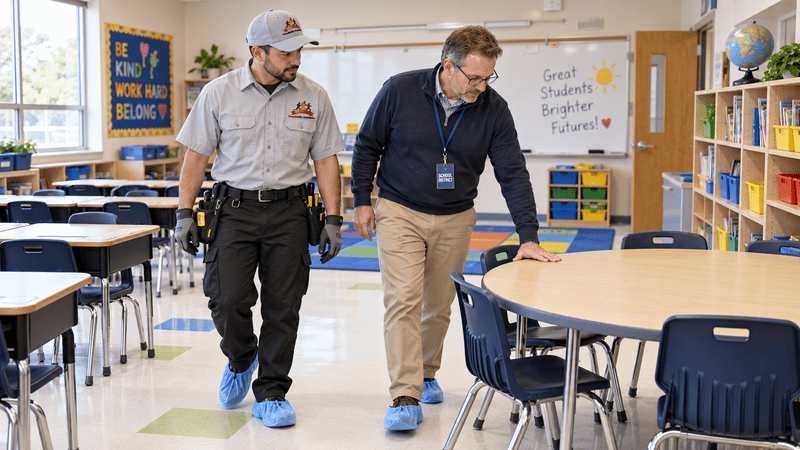
Why Schools Trust Professional Classroom Furniture Installation Services to Put Student Safety First