Smith Machine Assembly Tips for Safe Setup in Home Gyms and Fitness Centers
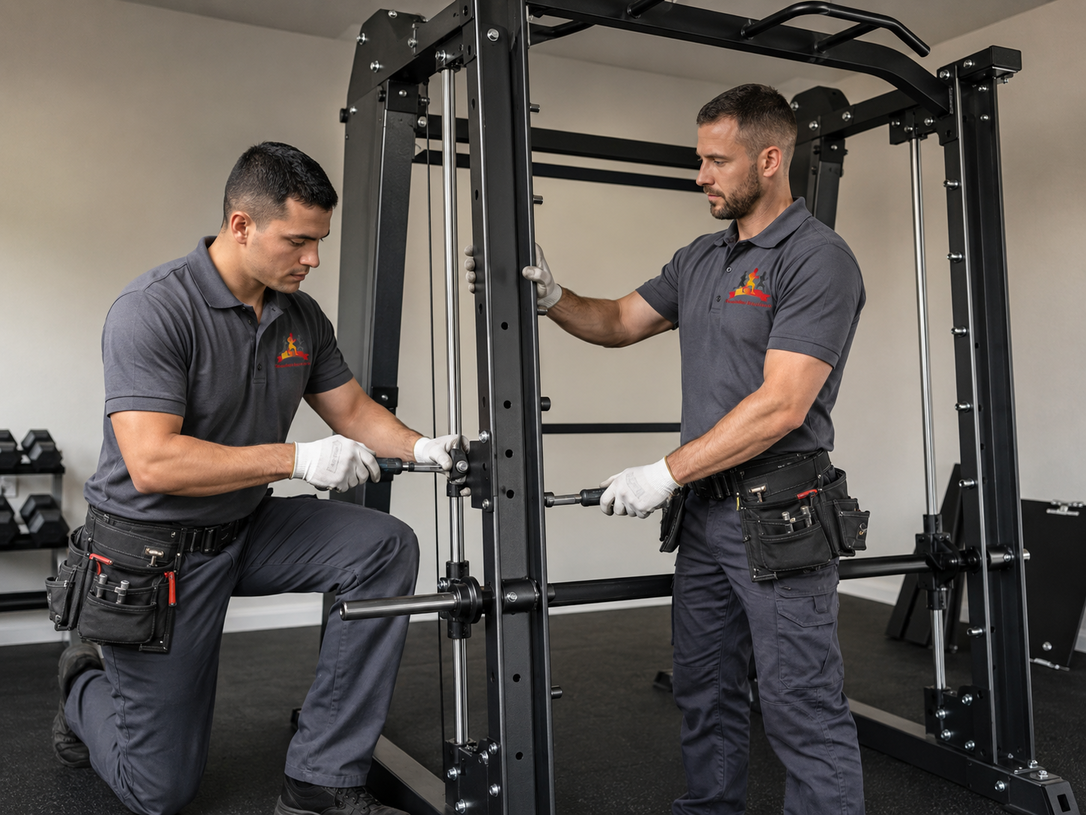
Proper Smith machine assembly keeps the frame stable, the guide rails aligned, and the bar path smooth, which directly improves lifting safety and equipment lifespan. Careful setup prevents wobbling, uneven bar movement, loose hardware, frame stress, and floor damage that often lead to unsafe lifting conditions. A correctly installed Smith machine performs better, lasts longer, and feels noticeably safer under load.
- Stable frame with tightly torqued hardware that resists shifting under heavy weights
- Safer lifting environment with reliable safety stops and predictable bar travel
- Correct rail and bar alignment for smooth, friction-free vertical motion
- Floor protection and even weight distribution across the base
- Long-term durability, fewer repairs, and consistently smoother performance
Smith Machine Assembly for Safer Gym Setups
A Smith machine is not a piece of flat-pack furniture. It is a heavy, multi-part strength system with guide rods, counterbalances, pulleys, and a steel frame that can weigh several hundred pounds before plates are added. When bolts are under-torqued, rails sit out of plumb, or the base lands on uneven flooring, the entire lift becomes unpredictable. Cramped placement makes the problem worse, limiting bar travel and increasing injury risk.
Professional Smith machine assembly solves these issues by combining mechanical precision with field-tested setup practices for home gyms, training studios, apartment fitness rooms, rehabilitation facilities, and full-scale commercial centers.
Why Proper Smith Machine Assembly Matters for Safety
Proper Smith machine assembly matters because the machine guides hundreds of pounds along fixed rails directly above the lifter. Any misalignment, loose hardware, or unstable base turns a controlled lift into a hazard. Correct setup ensures the bar tracks smoothly, the safety hooks engage reliably, and the frame stays rigid under repeated heavy loading.
A wobbly Smith machine often signals deeper assembly problems. In a busy commercial gym, that wobble multiplies across hundreds of weekly users. In a home gym, it can mean a failed rep with no spotter nearby. Following solid fitness installation safety practices reduces these risks from day one.
Key safety benefits of correct assembly include:
- Reliable bar catches that engage at every hook position
- Frame rigidity that prevents flex during heavy squats or presses
- Properly seated bushings and bearings for predictable bar travel
- Secured plate horns that hold weights without rattling loose
How Incorrect Assembly Affects Workout Performance
Incorrect assembly directly degrades workout performance. When rails are slightly out of parallel, the bar binds, sticks, or jerks through the range of motion. Lifters end up compensating with poor form, which limits strength gains and increases joint strain over time.
Sticky Bar Path and Inconsistent Reps
Even a few millimeters of rail misalignment creates friction points. You will feel it as a sticky spot in the middle of a press or a sudden catch at lockout. Browsing Smith machine features on quality units shows how tight tolerances are designed into the equipment, but only proper assembly preserves them.
Compromised Progressive Overload
If the machine feels different from one session to the next, tracking real progress becomes impossible. Stable, well-aligned equipment gives lifters consistent feedback, which is essential for both general training and rehabilitation programming.
What Space Requirements Smith Machines Need
Smith machines typically need a footprint of about 7 by 7 feet and ceiling clearance of at least 8 to 9 feet. Adequate surrounding space is critical for safe bar loading, full squat depth, and emergency bailouts. Cramped placement is one of the most overlooked setup mistakes.
| Setting | Footprint Needed | Ceiling Height | Side Clearance |
|---|---|---|---|
| Home Gym / Garage | 7 ft x 7 ft | 8 ft minimum | 2 ft each side |
| Basement Gym | 7 ft x 8 ft | 8.5 ft minimum | 2 ft each side |
| Apartment Fitness Room | 8 ft x 8 ft | 9 ft minimum | 3 ft each side |
| Commercial Gym | 8 ft x 10 ft | 9 to 10 ft | 3 to 4 ft each side |
| Rehabilitation Facility | 9 ft x 9 ft | 9 ft minimum | 4 ft for wheelchair access |
Reviewing standard Smith machine options before installation helps confirm that the chosen model actually fits the available room.
Why Floor Support and Stability Matter in Gym Setups
Floor support determines whether a Smith machine stays level under load. A 600-pound machine with another 400 pounds of plates concentrates serious weight onto a small base. Uneven flooring, soft carpet, or thin foam tiles can cause tilting, hardware loosening, and long-term subfloor damage.
Stable setups usually include:
- Heavy-duty rubber mats rated for strength equipment
- Plywood underlayment over carpet or uneven concrete
- Leveling shims under base feet on older flooring
- Anchor points where the manufacturer allows wall or floor securing
In garage gyms, sloped concrete is common, and proper weight machine setup requires shimming and leveling before any bolts are fully tightened.
How Proper Alignment Improves Equipment Functionality
Proper alignment is what separates a Smith machine that feels premium from one that feels broken. When the guide rails are perfectly parallel and plumb, the bar glides effortlessly. When alignment is off, every rep fights against the equipment instead of building strength.
Plumb, Level, and Parallel
Technicians use levels and plumb lines to confirm vertical rails sit at exactly 90 degrees, or at the manufacturer-specified angle for slanted models. Even small deviations compound under heavy load.
Safety Hook Calibration
Each safety catch must engage cleanly at every notch on both sides simultaneously. If one side catches before the other, the bar can twist, which is especially dangerous during failed reps.
What Common Smith Machine Assembly Mistakes Should Be Avoided
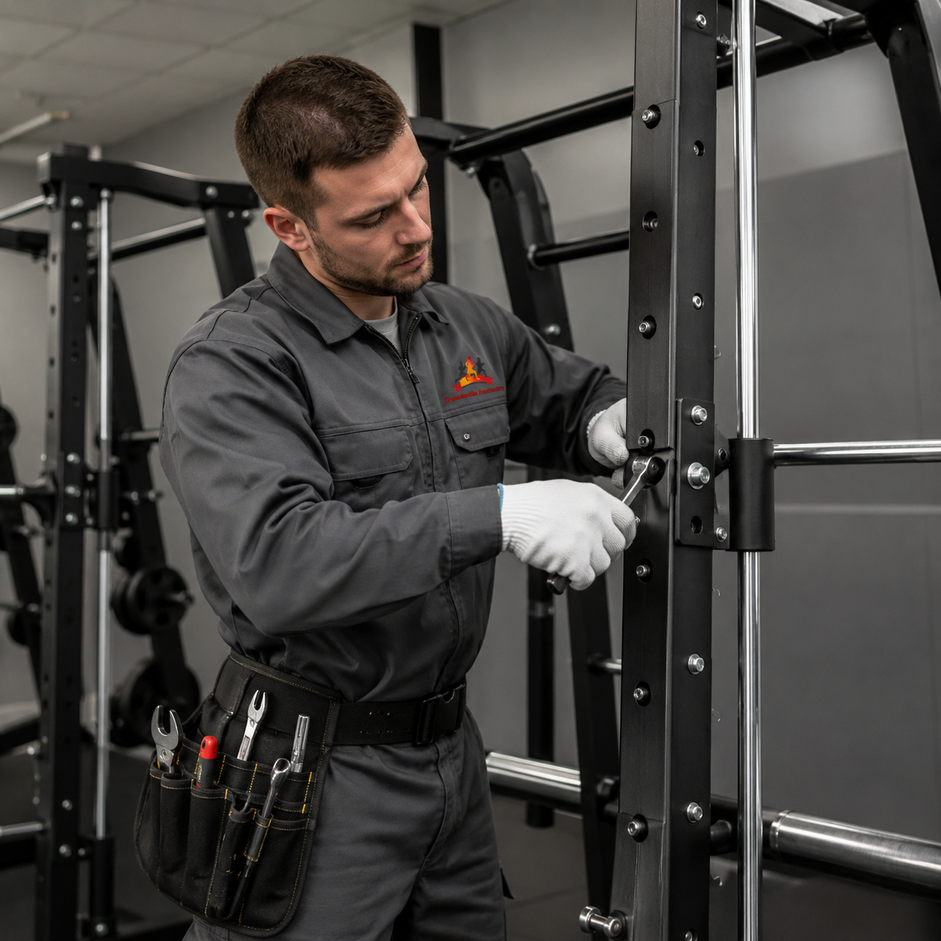
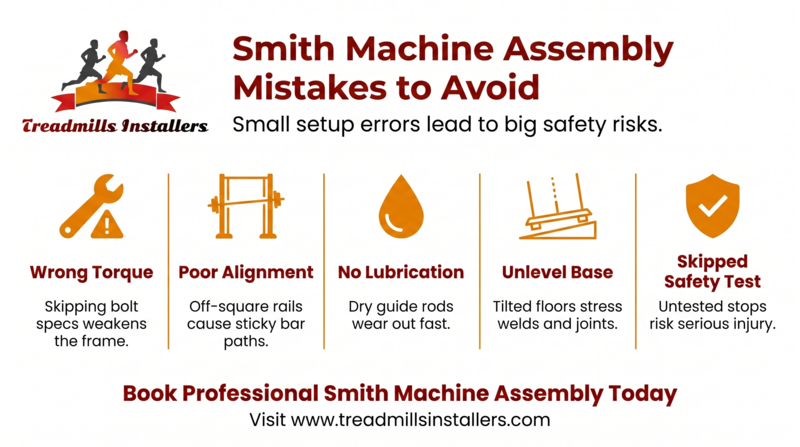
Common mistakes include skipping torque specs, tightening bolts in the wrong sequence, ignoring washers, and forcing parts that should slide together easily. These small errors create big problems once the machine is loaded with plates.
Mistakes to avoid:
- Fully tightening bolts before the frame is squared
- Skipping the manufacturer's torque values on critical fasteners
- Installing guide rods without lubrication
- Placing the machine on unlevel flooring without shims
- Forgetting to test safety stops before the first real lift
A professional Smith machine installation follows a documented sequence that prevents these issues from the start.
How Commercial Fitness Centers Handle Equipment Installation
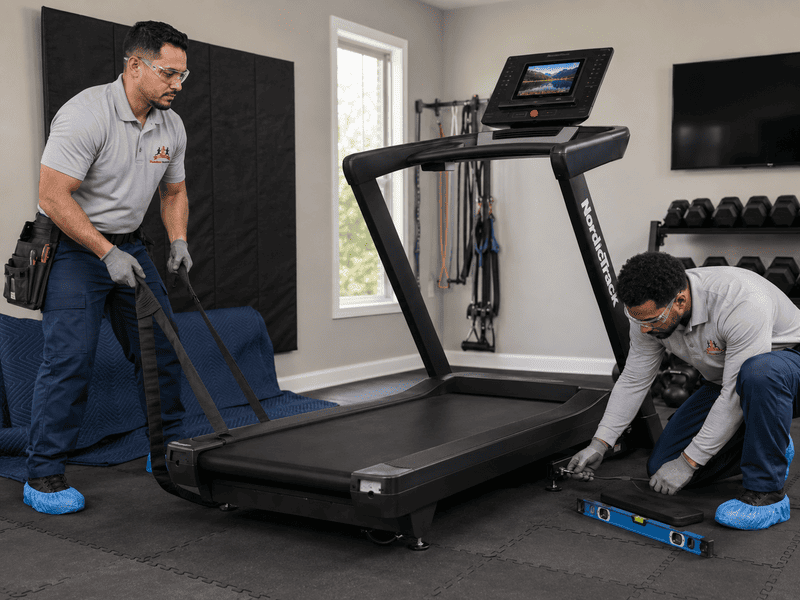
Commercial centers treat Smith machine setup as a structured project, not a quick build. Crews coordinate delivery, floor protection, assembly, alignment, anchoring, and final safety testing, often outside of operating hours to avoid disrupting members.
A typical commercial workflow looks like this:
- Protective floor covering laid across the install path
- Component inventory and hardware check before assembly begins
- Frame built in stages with squareness verified at each step
- Anchoring or ballasting based on local code and facility rules
- Load testing and final inspection signed off by a lead installer
Following published fitness product regulations is part of why facilities rely on experienced crews for commercial equipment assembly rather than in-house staff.
Why Professional Assembly Helps Prevent Equipment Damage
Professional assembly protects your investment. Smith machines can cost anywhere from a thousand to several thousand dollars, and improper setup often voids warranties. Trained installers know how to handle heavy steel components without bending frames, scratching finishes, or stripping threads.
Field crews also bring proper lifting equipment for the job. Coordinating heavy equipment moving into a basement or upstairs apartment fitness room is a job for specialists, not a two-person DIY attempt. The same applies during relocations, where careful equipment moving reinstallation preserves the machine's original integrity.
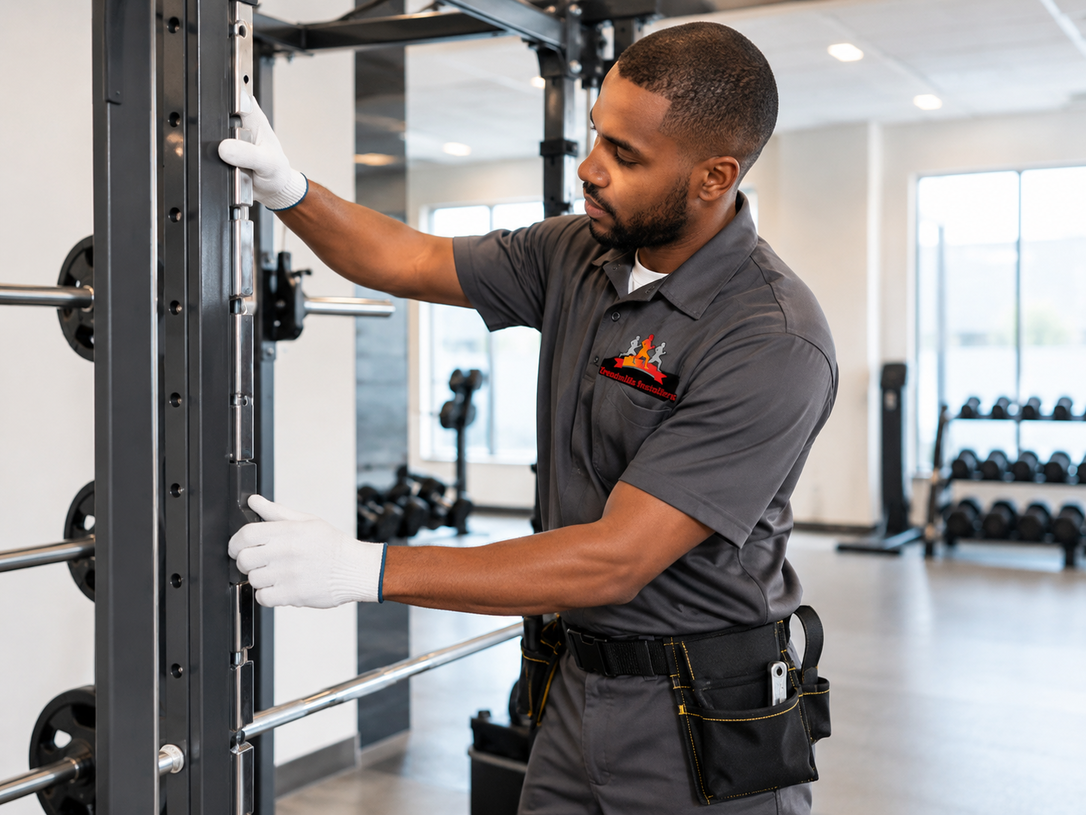
In short, Smith machine assembly services include unpacking, building, leveling, aligning, securing, and load-testing the frame, guide rails, safety stops, bar path, and weight bearing components so the equipment is stable, compliant, and ready for daily use.
When Homeowners and Gyms Should Hire Installation Services
Homeowners and facility managers should hire installation services any time the machine is large, heavy, or involves stairs, tight doorways, or uneven flooring. Professional help is also smart when warranties require certified setup or when multiple machines are being installed at once.
Hire professionals when:
- You are outfitting a new home gym, basement gym, or garage gym from scratch
- Your apartment fitness room or shared facility has access restrictions
- A school, office, or rehabilitation facility needs code-compliant setup
- Existing equipment needs relocation, and reliable moving hauling support is required
- You want documented, warranty-friendly Smith machine services from a trained crew
Get Reliable Smith Machine Assembly Help
Treadmills Installers delivers safe, stable, and professional Smith machine setup for home gyms, studios, and commercial facilities. Our crews focus on tight alignment, secure hardware, floor protection, and smooth bar travel so every workout feels solid from the first rep. We also support related projects, from polished reception area setup for studios and reliable shelving installation services for storage rooms, to full commercial installation support for larger fitness centers. Ready to book? Reach out to contact Treadmills Installers and schedule your assembly today.
Frequently Asked Questions About Smith Machine Assembly For Safety Tips
How do you assemble a Smith machine safely?
Start by reading the manual, organizing all hardware, and building the base on a level surface. Tighten bolts in stages, verify squareness throughout, and load-test the safety stops before any real lifting. For heavy or complex models, professional installation is the safest route.
How much space does a Smith machine need?
Most Smith machines need around 7 by 7 feet of floor space and 8 to 9 feet of ceiling clearance. Add at least 2 to 3 feet on each side for safe bar loading and comfortable movement. Commercial layouts often require even more clearance.
Does a Smith machine need floor protection?
Yes, floor protection is strongly recommended. Heavy-duty rubber mats or plywood underlayment protect both the flooring and the machine base from damage. They also dampen vibration and reduce noise during heavy lifts.
How long does Smith machine assembly take?
A standard assembly typically takes two to four hours for an experienced two-person crew. More complex commercial units with cables, pulleys, and counterbalances can take longer. DIY assembly often takes much longer, especially without proper tools.
What mistakes can damage gym equipment?
Skipping torque specifications, over-tightening bolts, ignoring leveling, and forcing misaligned parts are the most common damaging mistakes. Placing equipment on uneven floors also stresses frames and welds. These errors shorten the machine's lifespan significantly.
Is professional Smith machine installation worth it?
Yes, especially for heavy commercial models or warranty-sensitive equipment. Professionals ensure correct alignment, safe anchoring, and load-tested safety stops. The cost is small compared to potential injury, repair bills, or voided warranties.
How do you move and reinstall a Smith machine?
Partial disassembly is usually required, including removing the bar, guide rods, and weight horns. Components should be padded, lifted with proper equipment, and reassembled following the original setup sequence. Professional movers and installers make this far safer than a DIY attempt.